
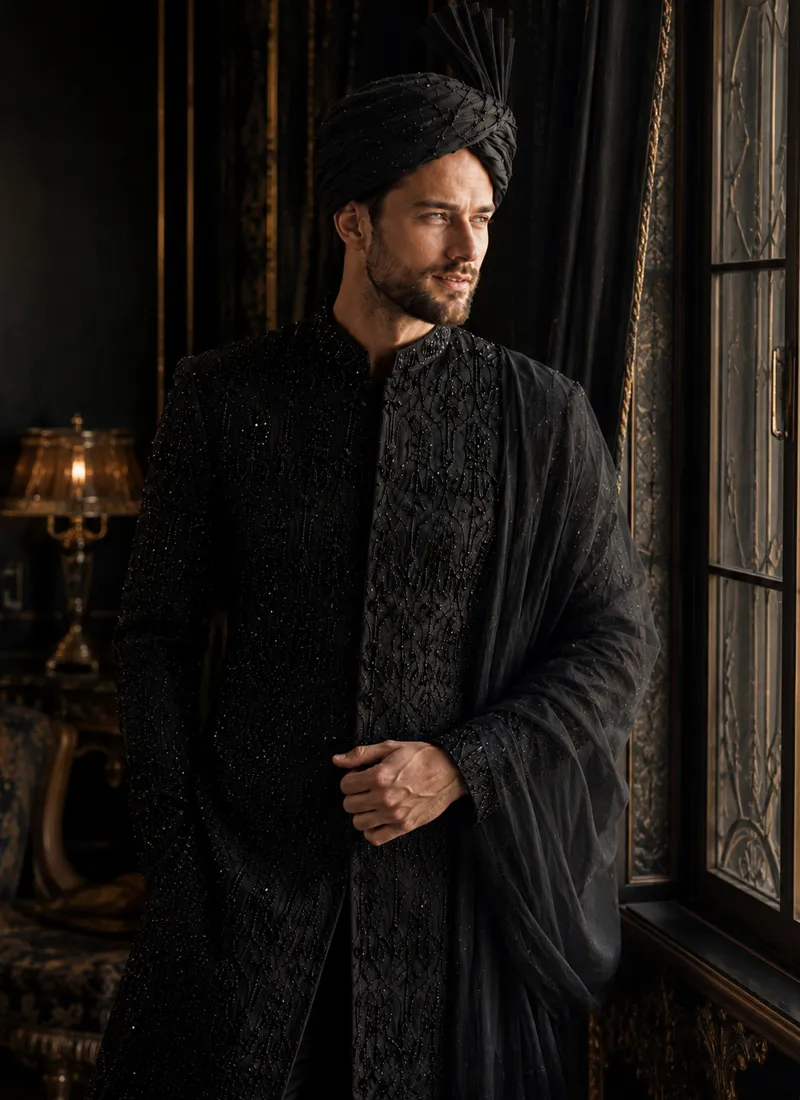
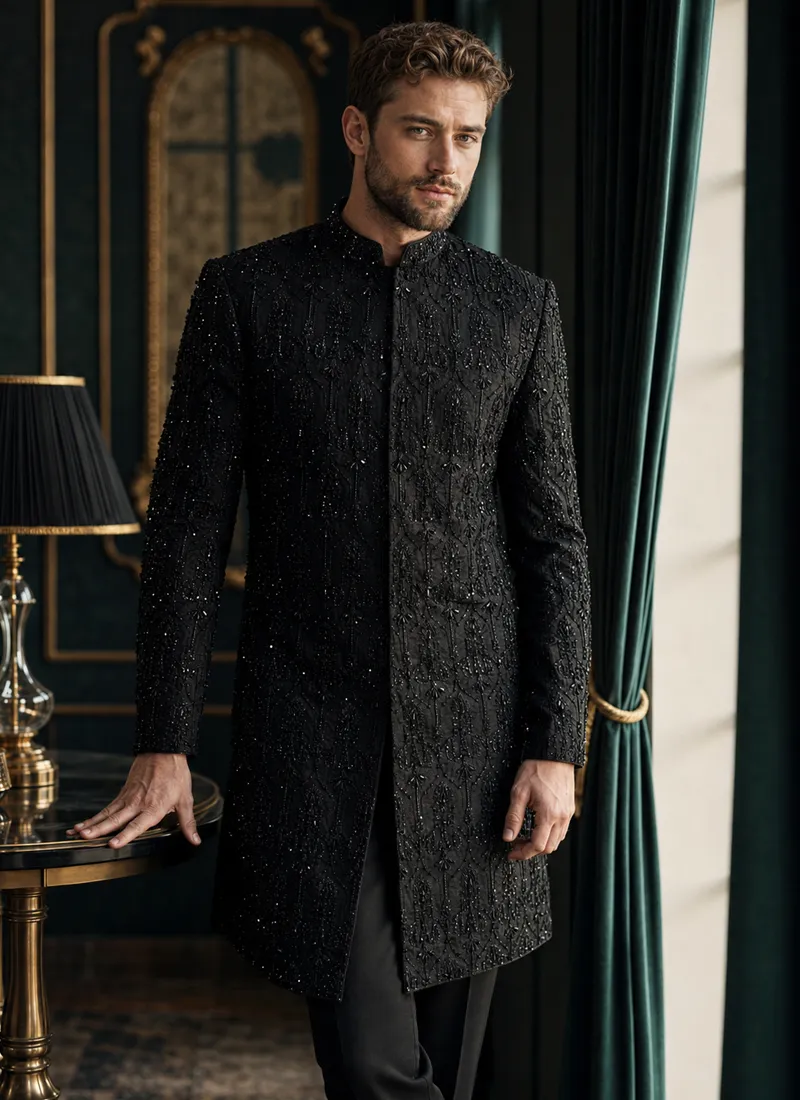
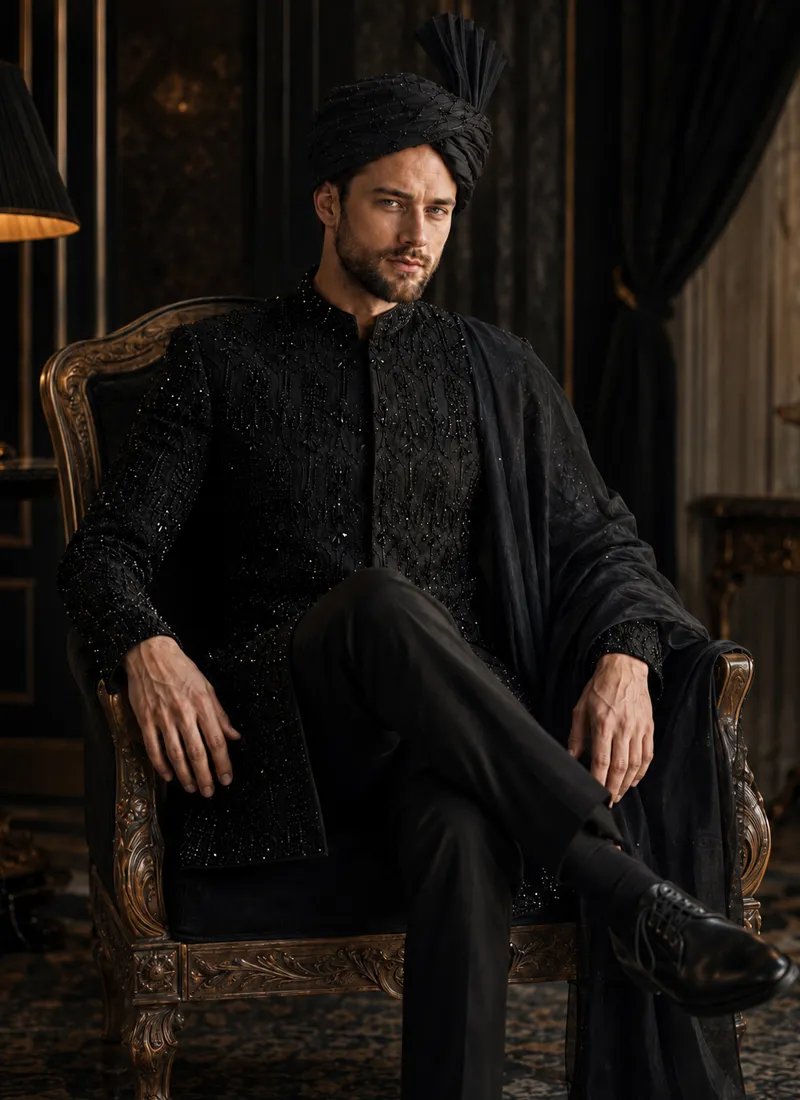
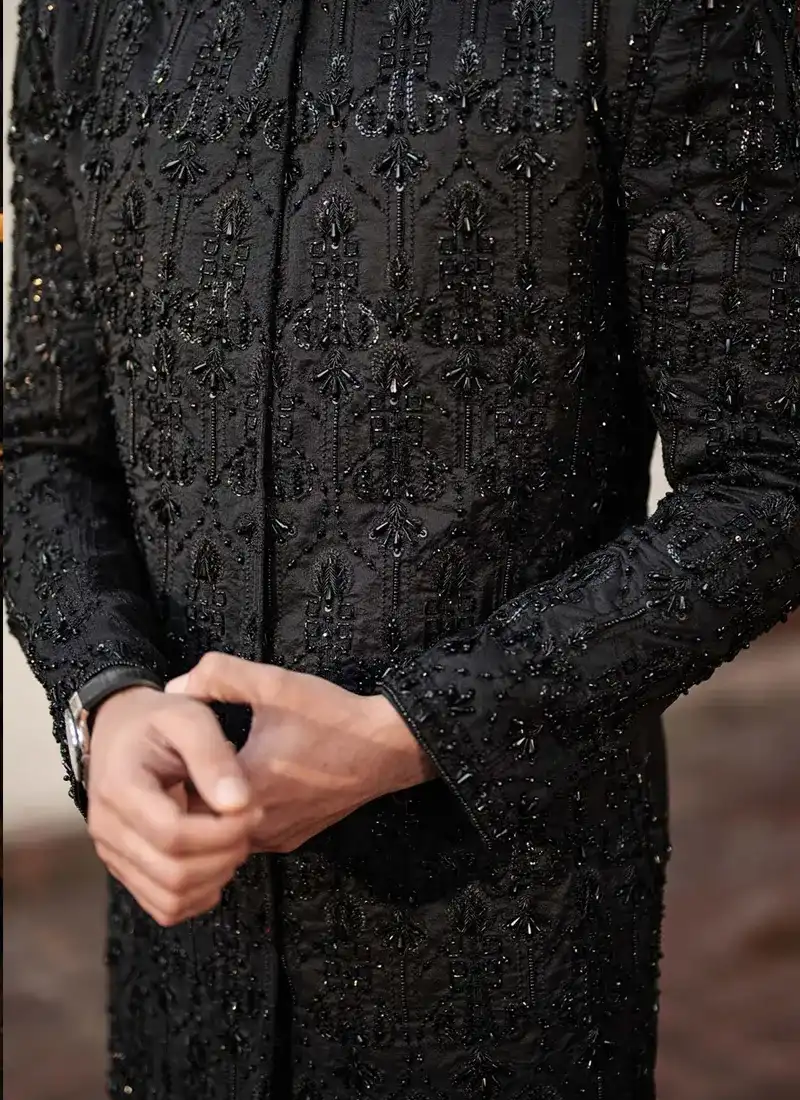


A black sherwani cut from Silk Jamawar and embroidered black on black, so the work reads through relief and reflection instead of colour. Black is the hardest colour to judge from a screen — it flattens in photographs in a way that lighter shades do not — which is why the detail below is worth reading before you decide.
Black Sherwani for Men: what you are looking at
Silk Jamawar forms the base. Because the embroidery sits in the same black as the cloth, none of the design depends on contrast: what you see is raised texture, the shift where light crosses a worked panel, and small points of reflection where sequins and metallic wire catch it. In shade the sherwani reads almost plain. Under direct or artificial light the pattern resolves. That behaviour is the whole point of a black-on-black garment, and it is the main reason this piece looks different in person from how it looks in an image.
Hand embroidery and machine threadwork
Two techniques are used, and the distinction is worth making plainly. The hand embroidery carries the embellishment — sequins, pearls, kora and dabka. Kora gives a matte metallic finish; dabka is a coiled wire that sits slightly raised from the cloth, and on a black ground it is what produces most of the visible relief. Machine threadwork continues across the body and the sleeves, filling and connecting the embroidered areas. This is a combination of hand and machine work, not an entirely hand-embroidered garment, and the surface should be judged on that basis.
Collar, front and silhouette
The collar is a high stand — the band collar that closes at the throat — and it carries the same tonal embroidered treatment as the body, so the line at the neck is worked rather than left plain. The front is clean, without a prominent row of exterior buttons, which keeps the embroidered surface unbroken down the centre. The silhouette is long and formal, reaching approximately 47 inches (about 119 cm) at its longest, and the sherwani is fully lined.
Sizing and measurements
Every sherwani here is made after the order is placed rather than taken from stock. You can choose a standard size from Small through to X-Large, or select Customized Size and supply your own measurements — neck, shoulders, sleeve length, full length, chest, waist and hips, alongside your height. Diagrams for each measurement sit next to the fields, so there is no guesswork about where the tape goes.
Measure over a thin shirt with a soft tape rather than working from your usual jacket size; the two scales do not correspond. If you fall between sizes or outside standard sizing, the customised route is the safer one on a garment this long — the shoulder line is the single point that cannot be corrected afterwards. Colour changes and selected adjustments to the embroidery or design can also be requested, subject to feasibility, and should be raised before the order is placed. Because each piece is produced to order, count the production time back from the wedding date before you decide.
What is supplied
This listing is for the sherwani itself. Matching pieces — a kurta pyjama, a turban and a shawl — can be added above before you order. Anything else visible in the photographs is shown for styling only.
Styling a black sherwani
Black behaves differently at a wedding from the lighter sherwani colours. It carries best under artificial light — a walima, an evening reception, an indoor nikkah — where the metallic work has something to catch. In flat daylight it reads more as a solid dark shape and the embroidery does less of the work. It also sits easily beside a bride in red or gold, setting a contrast rather than competing on the same register, which is part of why it has become a common choice for grooms who want something away from the traditional palette. Monochrome styling suits it: a black turban, a dark shawl, leather rather than gold-heavy accessories, and one accent only if you want one. Other colours and cuts sit alongside this one in our Groom Sherwani collection.
Caring for the embroidery
Professional dry cleaning is the recommended route. Do not machine wash. Do not iron directly over the embellished areas — press from the reverse at a low heat, or steam gently, keeping heat away from the sequins, pearls and metallic wire. Apply perfume to the skin rather than over the embroidery. Store the sherwani hanging in a dry place, in a breathable garment cover, with room around it so the raised work is not crushed, and handle the embroidered panels carefully to avoid snagging.
Specification
- Product type: Sherwani
- Colour: Black
- Fabric: Silk Jamawar
- Design character: Black-on-black tonal embroidery
- Embroidery: Hand embroidery with machine threadwork
- Handwork elements: Sequins, pearls, kora, dabka
- Placement: Body, sleeves and collar
- Collar: High stand / band collar, embroidered
- Front: Clean, without a prominent row of exterior buttons
- Silhouette: Long formal
- Length: Up to approximately 47 inches (about 119 cm)
- Lining: Fully lined
- Made to order: Yes — each piece is produced after the order is placed
- Sizing: Standard sizes Small to X-Large, or Customized Size with your own measurements
- Customisation: Colour, and selected embroidery or design changes, subject to feasibility
- Care: Professional dry cleaning recommended
Frequently asked questions
What fabric is this black sherwani made from?
The base fabric is Silk Jamawar, and the sherwani is fully lined, so the embroidered face of the garment sits over a finished inner layer.
What does black-on-black embroidery mean?
It means the embroidery is worked in the same black as the cloth rather than in a contrasting colour. The design shows through raised texture and reflected light instead of colour, so the sherwani looks restrained in shade and considerably more worked under direct or artificial light.
Is the embroidery done entirely by hand?
No, and it is worth being clear about it. The hand embroidery carries the embellishment — sequins, pearls, kora and dabka — while machine threadwork continues across the body and sleeves. The two work together across the surface.
Can this sherwani be made to my own measurements?
Yes. Select Customized Size and enter your own measurements — neck, shoulders, sleeve length, full length, chest, waist and hips — using the diagrams shown beside the fields. Standard sizes from Small to X-Large are also available if you prefer. Every piece is made after the order is placed.
What is supplied with this black sherwani?
The listing is for the sherwani. A matching kurta pyjama, turban and shawl can be added before you order. Anything else visible in the photographs is shown for styling only.
Is a black sherwani suitable for a groom?
Yes — it is cut as formal groom wear. Black works particularly well for evening events such as a walima or a reception, where the metallic handwork has light to catch, and it sits comfortably beside a bride wearing red or gold.
How should an embroidered Silk Jamawar sherwani be cared for?
Dry clean professionally. Do not machine wash, and do not iron directly over the embellished areas — press from the reverse at low heat or steam gently instead. Keep perfume off the embroidery, and store the sherwani hanging in a breathable cover with room around it so the raised work is not flattened.
Product Details
| Made In | Pakistan |
|---|
Sizing & Measurements
Choose a standard size, or select Customised Size and we stitch to your own measurements at no extra cost.
Your size or measurement details are provided before checkout is completed, which is why production can begin the day after you order. If a measurement is unclear, send it to us on WhatsApp before you submit it and our team will confirm it with you.
Care
- Always put paper between the layers when you fold it away. Kora, dabka and nakshi are metallic wire, and the fabric underneath them is fine. Every time the outfit is opened or folded, a stitch on one layer can catch the layer pressed against it and tear through it. A sheet of tissue or plain paper between the layers keeps the wire work away from the cloth, and it costs nothing. Use plain paper rather than newspaper on pale or ivory fabrics, because newsprint ink can mark them.
- Store it folded, not hanging. A heavily worked outfit is heavy, and months on a hanger pull the weight onto the shoulder seams.
- Dry clean only. Hand and machine washing damages metallic embroidery. Tell your cleaner the outfit carries zardozi, dabka or similar metallic handwork so it is cleaned by hand rather than by machine.
- Keep it away from direct sunlight and damp. Perfume and hairspray go on before the outfit, not after.
Questions About This Outfit
Can the design be customised?
Yes. Most customers ask for the design to be made a little more modest — higher neckline, longer or fuller sleeves, more coverage at the back, a longer shirt. Tell us what you want changed on WhatsApp before you order so the pattern is cut correctly the first time. Colour, embroidery colour, sleeves, neckline and length are all adjustable on most designs.
Will the dress look exactly like the photographs?
It will be very close, and we do not compromise on the embroidery or the fabric. Two honest exceptions: the colour shade can look slightly different because of studio lighting and your screen, and because every customer's height and body type is different, a pattern may need to be adjusted so the design sits correctly on you — on a shorter frame, for example, part of the shirt pattern may have to be re-cut. Ask for the final video before dispatch and you will see the actual garment before it ships.
Can I return or exchange it after delivery?
No. Every outfit is cut and stitched for one customer, so it cannot be resold or swapped for another size. That is exactly why the review happens before dispatch: ask for progress photographs and video at any stage, and for the complete final video before your order ships. An order can still be cancelled before dispatch — the windows and deductions are set out in our return policy.
Is there any extra cost on top of the price shown?
No hidden charges. The price you see is the price of the outfit. The only additions are the ones you choose yourself: Rush or Super Rush delivery, and any paid add-ons such as jewellery. Each is priced clearly before you pay.
Can I get matching jewellery with this outfit?
Yes. Matching earrings, necklace and related pieces are available as paid add-ons on this product — select them before you add the outfit to your basket and they are made and shipped with the same order.
Can I get a matching hijab or an extra dupatta?
Yes. Both are possible. Message us on WhatsApp when you place your order and we will tell you exactly how to arrange it.
Is Rush or Super Rush delivery available for this outfit?
Yes, on bridal and groom wear. The Estimated Delivery Timeline box near the top of this page shows live dates for Free, Rush and Super Rush against today's date, so it is always accurate for your order.
Payment
- Secure encrypted checkout
- Visa, Mastercard, American Express and other major debit and credit cards, processed through Stripe and PayPal
- PayPal
- Bank transfer is available on request with a 5% discount. It is arranged directly with our team on WhatsApp rather than at checkout.
- Payment is taken in full before production begins.